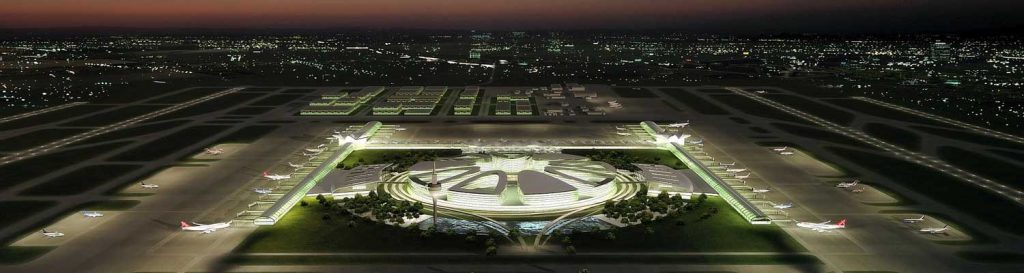
Every minute an aircraft spends circling or queuing burns fuel without bringing its passengers closer to their destination.
We invest enormous effort in making aircraft more efficient. Airport planning should pursue that same efficiency across the entire journey.
The larger, the better?
More runways, larger terminals and greater traffic concentration can add capacity. But size alone says little about how well an airport works.
Nowadays extremely Long taxi routes, congested aprons, distant gates and complicated transfers may consume much of the advantages gained in the air.
The TurnKey-Innovations’ Green Airports approach starts with a different ambition – make every movement count.
We favour compact, appropriately sized airports, shorter distances and coordinated operations. The objective is to reduce wasted fuel, time, space and energy while making travel easier for passengers and operations more predictable for airlines.
Efficiency begins before landing. Coordinated arrivals and well-designed approach procedures can reduce unnecessary holding and support continuous descents. On the ground, coordinated engine start-up, pushback and departure sequencing can reduce taxi time and queuing. These operational improvements have demonstrated fuel and emissions benefits.
Airport layout must support that flow. Runway exits, taxiways, stands and terminals should work together. Surrounding development must respect protected airspace and future operational requirements.
For passengers, the same principle applies: clear routes, convenient connections and shorter walks. A terminal should make the journey easier from arrival at the airport to boarding the aircraft.
The airport also belongs to a wider transport network. Passenger access, crew transport, cargo distribution, deliveries and emergency access all need to be planned together. Moving congestion beyond the airport boundary simply moves the problem.
Energy efficiency
begins with the building itself – orientation, shading, insulation and intelligent use of space. Renewable energy should then serve the remaining demand. Our approach explores solar thermal heating and heat-driven cooling, solar electricity and, where appropriate, concentrated solar power with thermal storage. Each solution must suit the location, operating requirements and aviation constraints. ICAO guidance recognises renewable energy opportunities at airports, including solar thermal applications, while requiring consideration of issues such as glare.
Our principal areas of focus are:
- Coordinated arrivals and efficient flight paths.
- Continuous descent approaches and efficient climb profiles.
- Runway exits designed for safe and efficient clearance.
- Short taxi routes and coordinated engine start-up.
- Departure sequencing that reduces unnecessary queues.
- Aircraft stands that simplify manoeuvring and reduce pushback requirements where feasible.
- Compact terminals with clear circulation and convenient transfers.
- Integrated access for passengers, crews, cargo and supplies.
- Building design that reduces heating and cooling demand.
- Solar shading, solarthermal heating and subsequent heat-driven cooling.
- Renewable electricity, energy storage and reliable backup power.
A Green Airport earns its name through how it works – in the Air and more so -on the Ground.
Our aim is an airport where good engineering makes efficient operation the natural way to travel.
contact: Richter (a tt) Turnkey-Innovations (do tt) com